Digitisation of cable plans
SCS wins an international ideas competition and supports Danish railways in the digitisation of cable plans. The information density of the cable plans is enormous: manual digitisation would take several years. SCS's concept is to largely automate these manual steps. Among other things, learning systems are to be used for automation.

-

Problem definition
Banedanmark has to digitise more than 10,000 cable plans. The information must be easily and quickly accessible and is particularly important for construction work so that no "forgotten" cables are torn out.
-
SCS solution
From semi-automatic to fully automated with a self-learning system - this was the credo of the SCS concept. Through close collaboration between man and machine, more and more work can be automated step by step.
-
How further
SCS's ideas have expanded the technological solution space for Danish Railways and are now being incorporated into the actual project implementation - a success for AI systems in the railway sector



Project insights
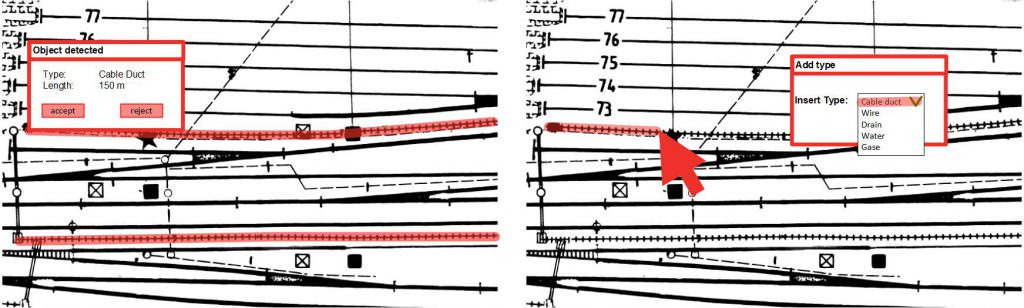
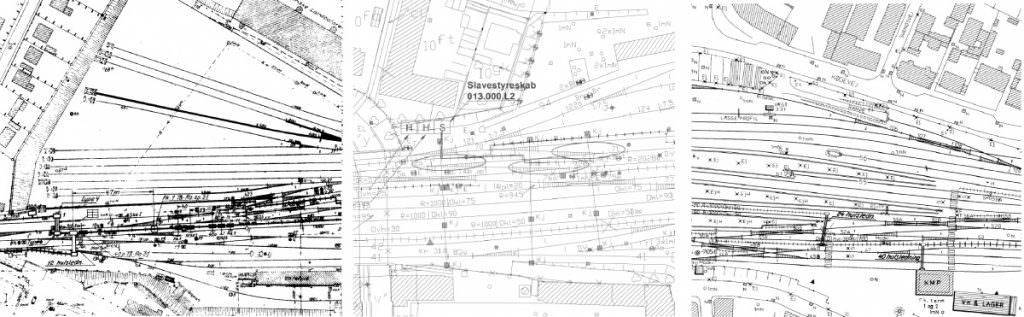
Banedanmark’s cable plans vary in age, quality and scale (Fig. 1). The information density of the cable plans is enormous: manual digitisation would take several years. The SCS concept envisages automating these manual steps to a large extent. Among other things, learning systems are to be used for automation. AI-based systems need a lot of labelled data that can be used to train the algorithms. Reliable learning is only possible with a solid “ground truth”. Among other things, the SCS concept optimises the creation of a reliable ground truth.
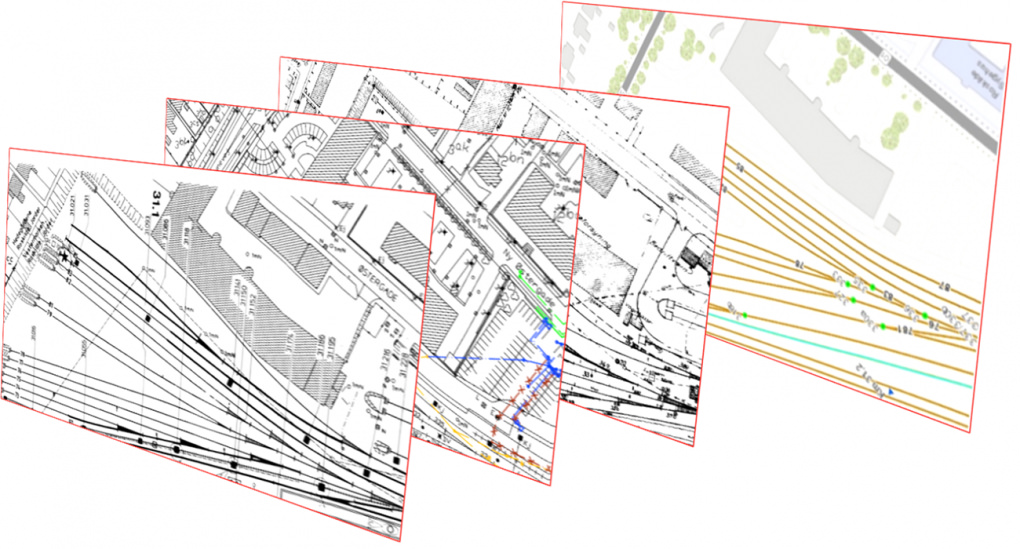
Several cable plans from the last few decades are available for the individual locations. The plans are first located and superimposed (Fig. 2). Different plans for the same location often contain complementary information, which represents a great opportunity as it can be used to massively optimise the creation of a ground truth. Like the Rosetta Stone, it can help to recognise unknown information in one plan by already known information in another. This allows the creation of a ground truth to be massively optimised.
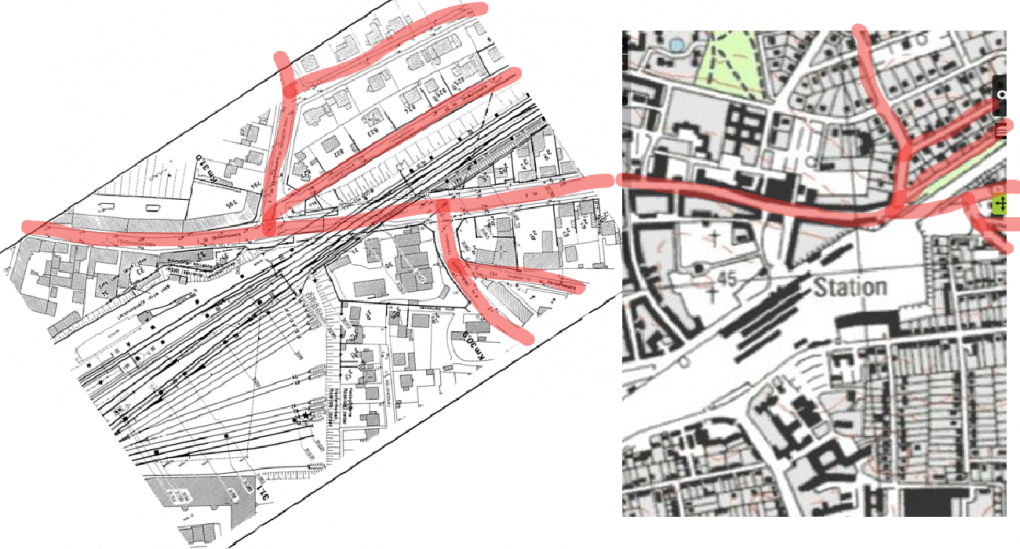
Localisation takes place in two steps. In the first step, the map is roughly localised and the station or railway line is determined using, for example, character recognition. In the second step, the map is finely localised. Fine localisation is carried out by correlating e.g. streets (Fig. 3) on the map with a map.