
Abstract
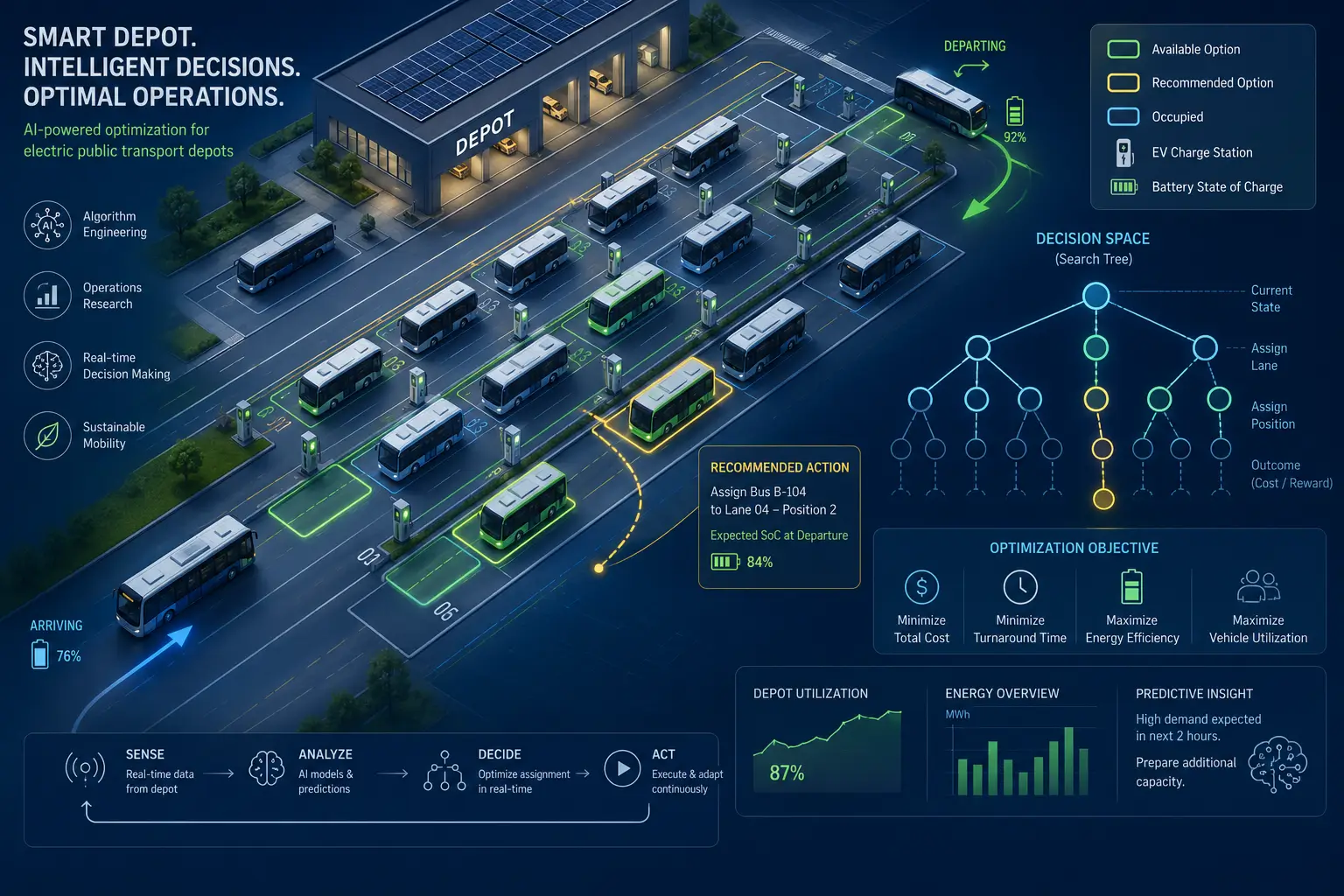
Vehicle depots represent a challenging real-world environment for online decision-making. Vehicles are often parked one behind the other in lanes to save space. However, this arrangement leads to blocking restrictions: only the frontmost vehicle in a lane can exit directly. Consequently, every parking decision influences whether suitable vehicles will be available for scheduled shifts at a later time. The situation becomes even more complex when vehicle types, battery state of charge, charging processes, heterogeneous lane and surface layouts, and operational disruptions such as delays must also be taken into account.
The aim of this thesis is to investigate robust decision strategies for the real-time control of vehicle depots. The focus is on selecting appropriate actions for arriving and departing vehicles, as well as necessary shunting movements within the depot to avoid operational congestion or deadlocks. Building on an existing Java-based framework and simulator, the study will investigate whether more general and transferable strategies can be developed that do not depend on depot-specific heuristics. Possible directions include interpretable rule-based or search-based methods, machine learning or AI-based approaches, or hybrid combinations thereof.
Background
Efficient depot operations are crucial for reliable public transportation, especially given the increasing use of electric vehicles. In many depots, vehicles are parked one behind the other in lanes. While this structure utilizes available space efficiently, it imposes significant operational constraints, as only the first vehicle in a lane is immediately available for departure. An unfavorable parking decision can therefore lead to an incoming vehicle being unable to park or a scheduled outgoing shift being unable to be served by a suitable vehicle.
In addition to these accessibility restrictions, depot control must also consider vehicle type compatibility, battery state of charge, charging processes, varying vehicle lengths, heterogeneous parking layouts, and disruptions such as delays or temporarily unavailable parking spaces. Since decisions must be made online and under strict runtime requirements, this is a practically highly relevant and computationally demanding discrete optimization problem.
An existing software framework and a benchmarker in Java are already available. The current baseline approaches work well for a specific depot setting but are based on heuristics tailored specifically to that depot, which may limit their generalizability. The goal of this thesis is therefore to investigate alternative action selection strategies that are more robust and can be better transferred to different depots and operating conditions.
Information
- Master’s thesis for 1 person (Bachelor’s thesis also possible)
- 30% theory, 70% implementation
Requirements
Ideally, knowledge in some of the following areas:
- Algorithms and data structures
- Discrete optimization / Operations Research
- Search methods
- Machine Learning / AI
- Java programming
Goal & Scope of the Thesis
The goal of the thesis is to develop and evaluate a robust strategy for the online control of vehicle depots that is more transferable to different depots and operating conditions than existing heuristic approaches. The expected outcome is an implemented and experimentally validated method that reliably supports real-time decisions for parking, dispatching, and shunting vehicles while accounting for charging and operational restrictions. The work should contribute to the practical automation of depot processes and create a foundation for more scalable and transferable decision support systems in public transportation.
Literature Review
Investigation of existing approaches from the fields of discrete optimization, online decision-making, search algorithms, and machine learning / AI for solving constrained operational planning problems.
Method Development
Analysis of the existing framework and baseline approaches. Design, implementation, and improvement of a new strategy for real-time action selection. Possible directions include white-box methods such as rule-based or search-based methods, black-box approaches from AI or machine learning, or hybrid methods combining both. The most promising direction can be selected after an initial analysis.
Evaluation
Comparative analysis of the developed method against existing baseline approaches using the provided simulator and benchmarker. The evaluation should include multi-day simulations, real-world depot instances, and, if necessary, additional synthetic depot layouts. Relevant performance indicators include feasibility, robustness to disruptions, runtime behavior, and the ability to avoid deadlocks.
Apply
Interested? Then send us your CV along with a brief statement of your motivation for this thesis to thesis@scs.ch.
Related Posts
No posts available.